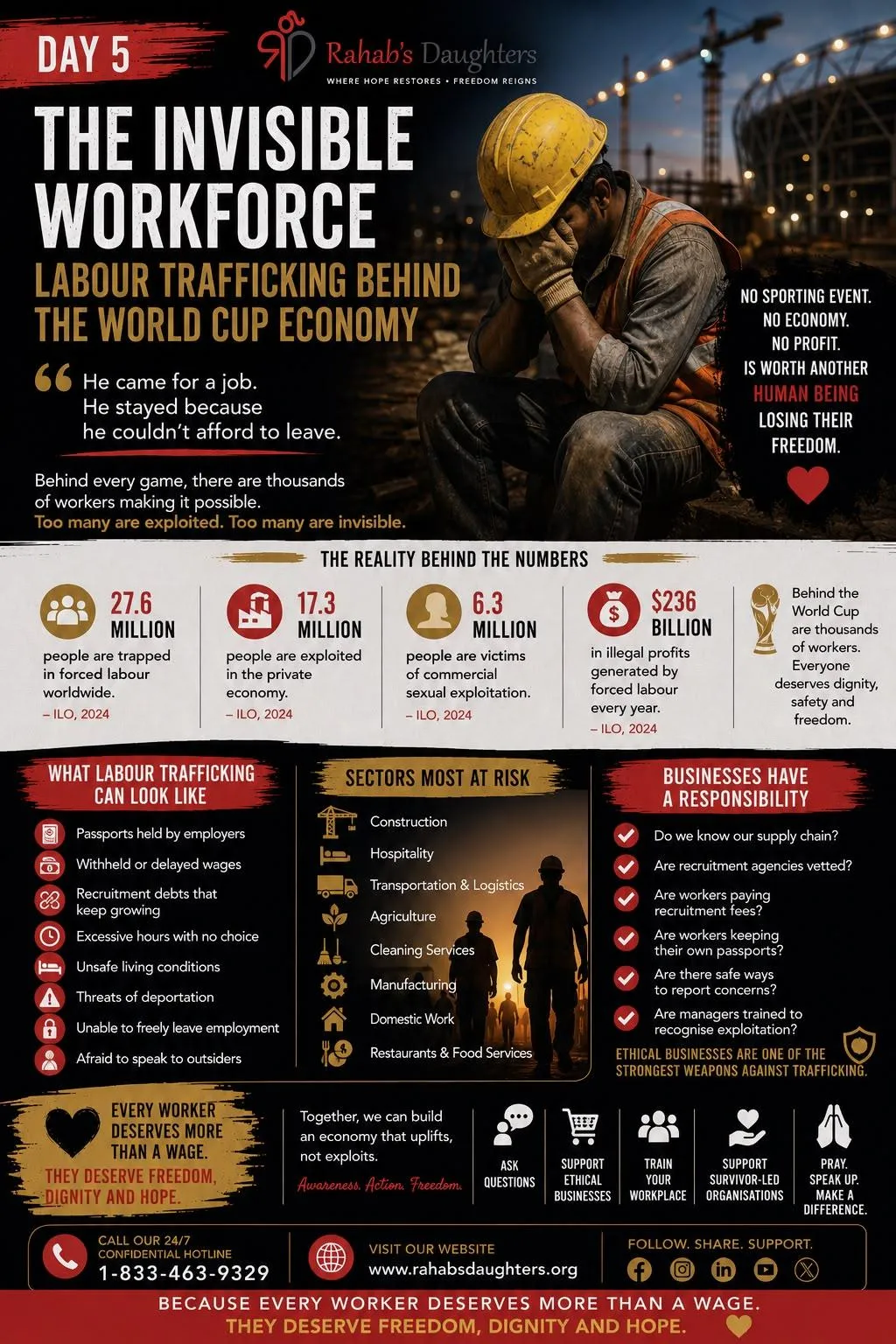
Day 5: The Invisible Workforce – Labour Trafficking Behind the World Cup Economy
“He came for a job.
He stayed because he couldn’t afford to leave.”
When David boarded the plane, he carried a photograph of his wife and two children in his wallet.
The recruitment agency promised him everything he had prayed for.
Good wages.
Safe accommodation.
A chance to finally give his family a better life.
To secure the job, he borrowed money from relatives and local lenders to pay recruitment fees.
“It’s an investment in your future,” they told him.
When he arrived, the reality looked very different.
His passport was taken “for safekeeping.”
The wages he had been promised never arrived.
The accommodation housed twelve men in a room built for four.
Every month he was told that deductions for food, transport, accommodation, visas, and administration fees meant there was little money left.
Going home wasn’t an option.
He owed too much.
His family depended on him.
He was trapped.
⸻
The Human Cost Behind Global Events
When we watch the World Cup, we see athletes, stadiums, celebrations, and unforgettable moments.
What we don’t see are the thousands of workers who make these events possible.
Construction workers.
Cleaners.
Kitchen staff.
Drivers.
Security guards.
Laundry workers.
Ground crews.
Hospitality teams.
Most are treated fairly and work incredibly hard to deliver extraordinary events.
But globally, vulnerable migrant workers can face exploitation, debt bondage, withheld wages, and coercion that can amount to labour trafficking.
⸻
Labour Trafficking Is Human Trafficking
The International Labour Organization estimates that 27.6 million people are trapped in forced labour globally.
Of those:
* Approximately 17.3 million people are exploited in the private economy.
* Around 6.3 million are victims of commercial sexual exploitation.
* Millions more are exploited in agriculture, construction, manufacturing, domestic work, hospitality, and transport.
Forced labour generates an estimated $236 billion in illegal profits every year.
Human trafficking has become one of the most profitable criminal industries in the world.
⸻
What Labour Trafficking Can Look Like
It isn’t always obvious.
Sometimes it looks like:
🚩 Passports being held by employers.
🚩 Workers afraid to speak to outsiders.
🚩 Wages being withheld or delayed.
🚩 Recruitment debts that keep growing.
🚩 Excessive overtime without choice.
🚩 Unsafe living conditions.
🚩 Threats of deportation if complaints are made.
🚩 Workers unable to freely leave their employment.
Trafficking does not require locked doors.
Debt can be a prison.
Fear can be a prison.
Isolation can be a prison.
⸻
The Sectors Most at Risk
Labour trafficking can happen in any industry, but some sectors remain particularly vulnerable:
🏗️ Construction
🏨 Hospitality
🚛 Transportation and logistics
🌾 Agriculture
🧹 Cleaning services
🏭 Manufacturing
🏠 Domestic work
🍽️ Restaurants and food services
The World Cup shines a spotlight on many of these industries.
That spotlight should include worker welfare.
⸻
Businesses Have a Responsibility
Every organisation has a role to play.
Questions businesses should ask include:
* Do we know our supply chain?
* Are recruitment agencies vetted?
* Are workers paying recruitment fees?
* Are workers keeping their own passports?
* Are there safe ways to report concerns?
* Are managers trained to recognise exploitation?
Ethical businesses are one of the strongest weapons we have against trafficking.
⸻
Why Rahab’s Daughters Talks About Labour Trafficking
When people hear “human trafficking,” they often think only of sexual exploitation.
Survivors know the truth is much broader.
Human trafficking is about exploitation for profit.
That exploitation can happen in brothels.
It can happen in factories.
It can happen in farms.
It can happen in kitchens.
It can happen in hotels.
It can happen in plain sight.
⸻
A Final Reflection
As the World Cup continues, remember this:
The people serving meals, cleaning rooms, driving buses, washing uniforms, and maintaining venues deserve dignity, safety, and freedom.
No sporting event.
No business opportunity.
No profit margin.
No trophy.
Is worth another human being losing their freedom.
⸻
Take Action Today
❤️ Support ethical businesses.
❤️ Ask questions about supply chains.
❤️ Learn the signs of labour trafficking.
❤️ Train your workplace.
❤️ Support survivor-led organisations such as Rahab’s Daughters.
Because every worker deserves more than a wage. They deserve freedom, dignity, and hope.