Day 8: Survivor Voices – What Trafficking Really Looks Like
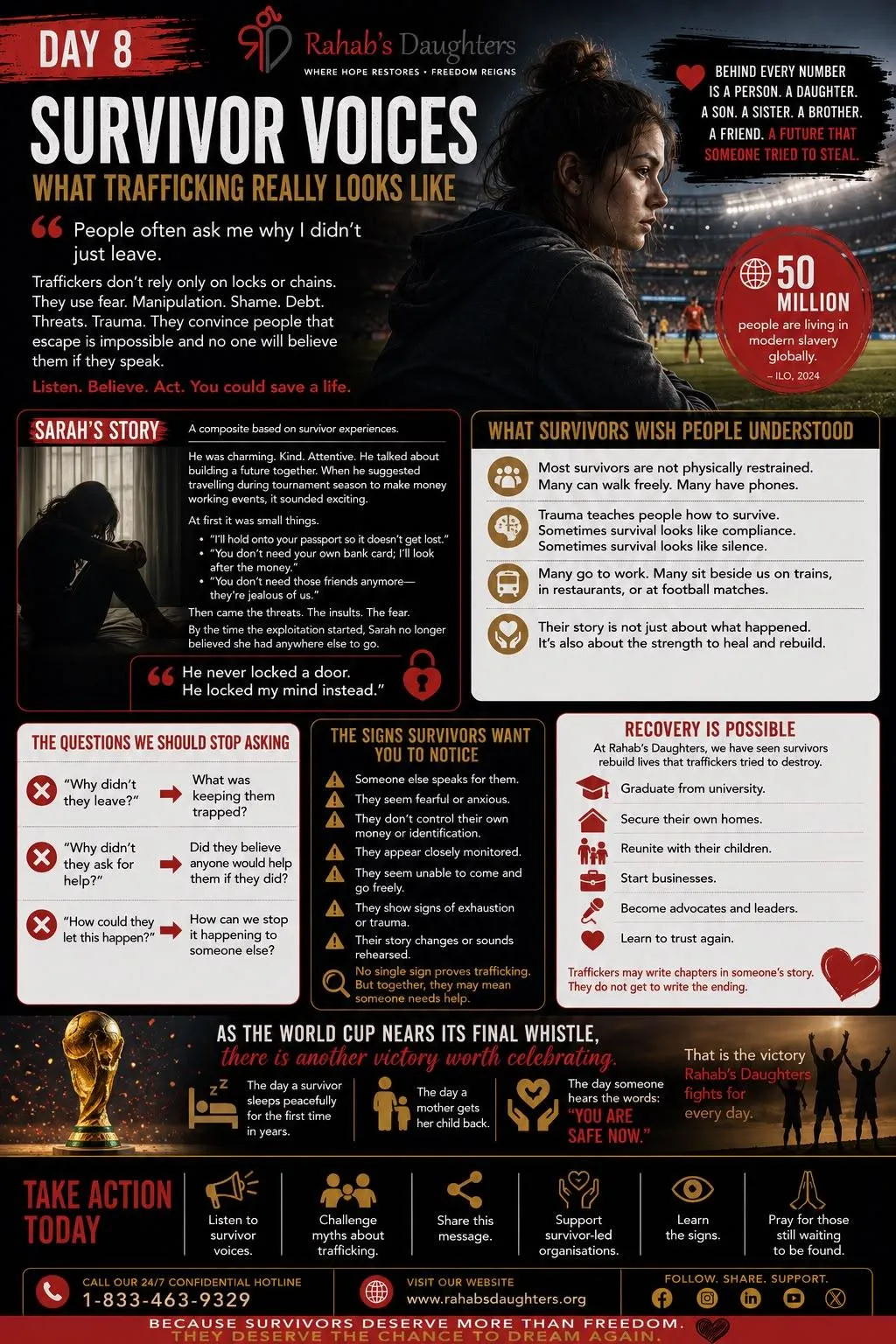
“People often ask me why I didn’t just leave.”
For survivors of human trafficking, that question can hurt almost as much as the memories themselves.
Because if leaving were as simple as walking away, there would be no victims.
Traffickers do not rely only on locks or chains.
They use fear.
Manipulation.
Shame.
Debt.
Threats.
Trauma.
They convince people that escape is impossible and that no one will believe them if they speak.
As the World Cup enters its final days, it is important that we hear the voices of survivors rather than the myths of Hollywood movies and headlines.
Sarah’s Story
The following story is a composite based on the experiences of trafficking survivors.
Sarah was nineteen when she met him.
He was charming.
Kind.
Attentive.
For the first time in a long time, she felt seen.
He bought her gifts.
He listened to her dreams.
He talked about building a future together.
When he suggested travelling with him during the tournament season to make some money working hospitality events, it sounded exciting.
Temporary work.
Good money.
Adventure.
Opportunity.
Instead, it became control.
At first it was small things.
“I’ll hold onto your passport so it doesn’t get lost.”
“You don’t need your own bank card; I’ll look after the money.”
“You don’t need those friends anymore—they’re jealous of us.”
Then came the threats.
The insults.
The fear.
By the time the exploitation started, Sarah no longer believed she had anywhere else to go.
Years later she would say:
“He never locked a door.
He locked my mind instead.”
What Survivors Wish People Understood
Most survivors are not physically restrained.
Many can walk freely.
Many have phones.
Many smile.
Many go to work.
Many sit beside us on trains, in restaurants, or at football matches.
Trauma teaches people how to survive.
Sometimes survival looks like compliance.
Sometimes survival looks like silence.
Sometimes survival looks like pretending everything is okay.
The International Labour Organization estimates that nearly 50 million people are living in modern slavery globally, including forced labour and forced marriage.
Behind every number is a person.
A daughter.
A son.
A sister.
A brother.
A friend.
A future that someone tried to steal.
The Questions We Should Stop Asking
Instead of asking:
❌ “Why didn’t they leave?”
Ask:
✅ “What was keeping them trapped?”
Instead of asking:
❌ “Why didn’t they ask for help?”
Ask:
✅ “Did they believe anyone would help them if they did?”
Instead of asking:
❌ “How could they let this happen?”
Ask:
✅ “How can we stop it happening to someone else?”
The Signs Survivors Want You To Notice
🚩 Someone else speaks for them.
🚩 They seem fearful or anxious.
🚩 They do not control their own money or identification.
🚩 They appear closely monitored.
🚩 They seem unable to come and go freely.
🚩 They show signs of exhaustion or trauma.
🚩 Their story changes or sounds rehearsed.
No single sign proves trafficking.
But together, they may mean someone needs help.
Recovery Is Possible
At Rahab’s Daughters, we have seen survivors rebuild lives that traffickers tried to destroy.
We’ve seen survivors:
🎓 Graduate from university.
🏠 Secure their own homes.
👩👧 Reunite with their children.
💼 Start businesses.
🎤 Become advocates and leaders.
❤️ Learn to trust again.
Traffickers may write chapters in someone’s story.
They do not get to write the ending.
A Final Reflection
As the World Cup nears its final whistle, millions will celebrate victory on the pitch.
But there is another victory worth celebrating.
The day a survivor sleeps peacefully for the first time in years.
The day a mother gets her child back.
The day someone hears the words:
“You are safe now.”
That is the victory Rahab’s Daughters fights for every day.
⸻
Take Action Today
❤️ Listen to survivor voices.
❤️ Challenge myths about trafficking.
❤️ Share this message.
❤️ Support survivor-led organisations.
❤️ Learn the signs.
❤️ Pray for those still waiting to be found.
Because survivors deserve more than freedom. They deserve the chance to dream again.
Call 1-833-4newday to report anything or if you need help.
Donate to assist us in helping women and children out or modern slavery